Choosing a storm protection or security product for a residential or commercial property is one of the most consequential building envelope decisions a property owner makes. It is also one of the least systematically evaluated. Most buyers focus on upfront cost and wind rating without asking the question that determines true value over time: how long will this system actually last, what does it cost to keep it functioning, and when does it begin to fail?
This study compares four major storm protection and security systems, aluminum shutters, steel shutters, impact windows, and security grilles, across four dimensions: documented lifespan range, average expected service life under real-world conditions, maintenance requirements and intervals, and failure modes that shorten or extend service life. All data is drawn from manufacturer specifications, independent building industry assessments, and verified field performance data.
The core finding: no single product wins across every dimension. The right choice depends on climate, use case, budget horizon, and what type of maintenance a property owner is realistically prepared to commit to. But the data reveals significant and largely underappreciated differences that most buyers never see before they sign a purchase agreement.
Part One: Aluminum Shutters
Lifespan Data
Aluminum hurricane shutters have a documented lifespan range of 20 to 50 years, with an industry average of approximately 30 years. This range is wider than most buyers expect, and the spread reflects a genuine divergence between well-maintained coastal systems and inland shutters that receive consistent care. Aluminum shutters last 25 to 35 years in most residential installations, and may need to be repainted approximately every 10 years to extend their lifespan to 25 years or more.
For hurricane-rated aluminum specifically, the construction standard matters significantly. Hurricane-impact aluminum shutters are typically built from extruded 6063 T-6 aluminum alloy components, with stiles and rails featuring 0.04-inch-thick walls, mitered corners connected with nylon keys and structural adhesive, and hinges permanently riveted to the shutter. Systems built to this specification consistently outperform lower-grade alternatives by a margin of 10 years or more in the field.
Maintenance Requirements
Aluminum shutters have one of the lowest maintenance burdens of any deployable storm protection system. The recommended maintenance schedule includes washing shutters every three months using a mild soap solution and a soft cloth, paying close attention to crevices where debris accumulates, followed by rinsing with clean water and drying with a soft cloth to prevent water spots.
For operational systems, applying graphite spray or wax spray in the side tracks two to four times per year and opening and closing shutters at least once a month helps keep tracks clear and slats moving smoothly. This monthly operation requirement is one of the most commonly neglected maintenance tasks and one of the most consequential. A shutter that has not been operated for six months is far more likely to fail to deploy when a storm warning is issued.
Failure Modes
Corrosion of securing hardware embedded in walls is a primary failure mode for aluminum hurricane shutters as they age. The shutter panels themselves resist corrosion well, but the fastening systems anchoring them to masonry or wood framing degrade over time in coastal environments. In coastal suburbs, the risk to aluminum shutters is not rusting in the steel sense, but rather surface corrosion at cut edges, fasteners, or locations where salt deposits collect and remain damp.
Powder-coat finish degradation is the most visible aging indicator. Aluminum offers excellent corrosion resistance, ensuring that shutters will last for many years without rusting, and requires minimal maintenance with the ability to withstand harsh weather conditions without needing regular painting or sealing. However, scratches that penetrate the coating in salt-air environments should be touched up promptly to prevent pitting.
Average service life: 25–30 years with maintenance. Up to 50 years in optimal inland conditions. As few as 15–20 years in neglected coastal installations.
Part Two: Steel Shutters
Lifespan Data
Steel shutters deliver the highest raw impact resistance of any deployable shutter system, but that strength advantage comes with a significant trade-off in corrosion vulnerability that directly affects service life. Steel roller shutters typically last around 10 to 20 years, depending heavily on rust protection, humidity, and the condition of fasteners and guides.
The range is notably narrower than aluminum, and the lower bound is lower. A well-protected, well-maintained steel shutter in a dry inland environment can push toward the 20-year ceiling. The same product installed near the coast without adequate coating maintenance may begin showing structural corrosion failure well before 10 years.
Finish selection is the single most important purchase decision for steel shutters. Steel shutters often have shorter warranty periods than some aluminum products because the material is more sensitive to environmental exposure. For buyers evaluating steel, the most important question is not only “how strong is it?” but also “what protection system does it have, and where will it be installed?”
Maintenance Requirements
Steel shutters require substantially more maintenance than aluminum to achieve comparable service life. Moisture left in tracks encourages rust particularly on steel models, and lubricating roller bearings and guide rails every six months extends the lifespan and smooth operation of roller shutters considerably. The lubricant choice matters: silicone-based products are recommended. WD-40 is explicitly contraindicated, as it displaces moisture short-term but does not provide lasting lubrication and can attract dust that clogs moving parts.
Coating inspection is the most critical maintenance task for steel shutters. Steel shutters are more likely to rust if the protective coating wears off, and repainting or recoating them periodically is necessary to maintain their protective layer. In practice, this means annual visual inspections for coating damage, prompt touch-up of any scratches that expose bare metal, and full recoating on a schedule of every five to seven years depending on environmental exposure.
Failure Modes
Common failure points in steel systems include crevice corrosion around fasteners, rust creep from scratched coatings, worn guides, and moisture retention at the bottom rail. Coastal homes, high-humidity regions, and properties exposed to irrigation overspray tend to shorten expected life.
For motorized steel systems, corrosion compounds the mechanical failure risk. If the shutter is motorized, corrosion at brackets and fixings can create load issues that increase strain on the motor over time. The combination of structural corrosion and mechanical motor failure is the primary reason steel shutters on neglected coastal properties frequently require full replacement rather than repair.
One area where steel genuinely outperforms aluminum is in security and forced-entry resistance. Steel is one of the strongest materials available for hurricane shutters, providing excellent protection against flying debris and extreme winds. For commercial applications where security against forced entry is the primary concern, not storm protection, steel’s raw strength advantage is meaningful and often justifies the higher maintenance commitment.
Average service life: 15–20 years with diligent maintenance. 10–12 years in coastal environments with average maintenance. Up to 25 years in dry inland settings with premium coatings.
Part Three: Impact Windows
Lifespan Data
Impact windows occupy a fundamentally different category from shutters. They are a permanent, passive system that requires no deployment, provides protection continuously, and does not depend on operator action before a storm. Their lifespan data reflects this architectural-grade installation standard. The lifespan of impact windows is typically 20 to 30 years, and many last even longer with proper care. High-quality impact windows installed by experienced professionals can protect a home for decades, and some manufacturers offer lifetime warranties.
The premium end of the market pushes this ceiling significantly higher. Aluminum and fiberglass frames in particular can last 40 to 50 years with proper care. The glass and seals may need attention sooner, but the overall window system can continue performing for decades. This creates a realistic maintenance scenario where the frame outlasts two or three seal replacement cycles, making the total ownership cost substantially lower than the initial price suggests.
Compared to conventional windows, the performance gap is significant. Impact doors and windows have a lifespan up to twice as long as ordinary aluminum or vinyl framed windows. Standard windows typically require replacement every 15 to 20 years. A quality impact window installation on the same schedule would be approaching only the midpoint of its service life.
Maintenance Requirements
Impact windows require the least operational maintenance of any system in this comparison — which is one of their defining advantages. Impact windows sit there for 25 years and never need a second thought in terms of storm deployment. The maintenance that is required focuses on preserving the frame seal integrity and glass performance.
Basic maintenance includes cleaning, inspecting seals, ensuring proper drainage, lubricating hardware, checking for cracks or damage, and occasional re-caulking. Cleaning frequency should increase in coastal environments: for homes in coastal regions or anywhere near saltwater, windows should be cleaned regularly with fresh water to remove any salt residue. Metallic tools, razor blades, putty knives, and abrasive pads should be avoided entirely, as they can damage the surface and void manufacturer warranties.
Professional inspections are recommended every few years and after any significant storm event. Some issues, like sealant failure or minor hardware problems, can often be repaired. However, significant structural damage usually requires replacement.
Failure Modes
The primary failure modes for impact windows are seal degradation and UV-driven material breakdown, not structural failure. UV radiation can degrade materials over time, affecting performance in homes in sunny climates or those with prolonged exposure to direct sunlight. UV exposure can cause fading or weakening of seals and frames, and regular maintenance including UV-protective coatings or treatments can help mitigate these effects.
Fogging between panes, caused by seal failure that allows moisture into the interlayer, is the most common visible aging indicator. Sticking frames, reduced insulation performance, and visible cracks or chips in the laminated glass are the key replacement signals. The coverage lengths in warranties vary by component: the frame might be covered for a lifetime while the glass is covered for 15 to 20 years and hardware for 10 years. This tiered warranty structure accurately reflects where aging shows up first in real-world installations.
The one critical caveat: the shutter deployment gap is the most underweighted variable in any comparison. A motorized roll-down system that nobody activates protects the house exactly as much as bare glass. Impact windows have no equivalent vulnerability, they are always active. This passive protection characteristic is one of the most practically significant advantages in the entire product comparison.
Average service life: 20–30 years standard. 40–50 years for premium aluminum or fiberglass frames with maintenance. Glass seals and hardware may require attention at the 10–15 year mark within an otherwise functional system.
Part Four: Security Grilles
Lifespan Data
Security grilles are distinct from the other three categories in one important respect: their service life is measured not just in years, but in operational cycles. A grille installed in a commercial storefront that opens and closes multiple times daily will age through mechanical wear at a different rate than an identical product installed on a seasonal property operated infrequently. Both dimensions of time and cycle count must be evaluated together.
On average, roller shutter doors last between 10 and 20 years, depending on how often they are used and how well they are maintained. The most common wear points are the rollers, bearings, springs, and motor, all of which are under constant strain. For high-cycle commercial installations, leading manufacturers now specify cycle-rated products. The Extreme High-Performance MicroCoil Grille is built to withstand at least 500,000 open and close cycles, ensuring a lifetime of smooth operation. The standard commercial box spring counterbalance is typically designed for 12,000 cycles, meaning a storefront operating the grille twice daily will exhaust a standard spring counterbalance in under 17 years.
For residential and lower-cycle applications, the two greatest benefits of a security grille are its low upfront cost and the fact that it requires little to no maintenance after installation.
Maintenance Requirements
Security grilles are among the most maintenance-efficient products in this comparison for their security function. Regular inspections are recommended at least twice a year to help maintain compliance and identify potential issues early, along with professional guidance on maintenance including lubrication of moving parts to prevent rust and ensure smooth operation.
For galvanized steel grilles specifically, the zinc coating provides substantial corrosion resistance, but the protective layer is not indefinite. Galvanized steel links and rods use a protective layer of zinc to guard against premature rust and corrosion. In coastal and high-humidity environments, the inspection frequency should increase to quarterly.
Motorized grille systems add a maintenance dimension around the drive mechanism. Annual professional servicing of motor, track alignment, and tension systems is standard practice for commercial operators. Manual systems have fewer failure points but still require track clearing, rod and link inspection, and hinge lubrication at regular intervals.
Failure Modes
Older grilles can act up over time, leading to difficulties rolling up or down and a diminished aesthetic appeal. The mechanical failure modes, track misalignment, spring fatigue, motor burnout — are distinct from the corrosion failure modes, and they interact. A track that has accumulated grit puts more load on the motor or spring counterbalance, accelerating mechanical wear. A spring that has fatigued creates uneven tension across the curtain, causing guide wear.
For stainless steel grilles in premium specifications, the service life extends considerably beyond standard galvanized products. Premium 316 marine-grade stainless steel contains molybdenum to block chemical attacks from salt and moisture, and high-quality security screens are designed to resist rust for decades. The same principle applies to grilles: the material specification at purchase defines the ceiling on what maintenance can achieve.
Average service life: 15–25 years in moderate-use residential and commercial applications. 10–15 years in high-cycle commercial settings without cycle-rated components. 25 years or more with premium stainless specifications and consistent maintenance.
Comparative Summary
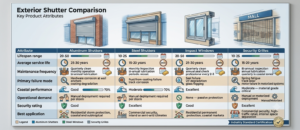
The table below synthesizes the core findings across all four systems:
Key Findings
Finding 1: Aluminum shutters and impact windows have the longest and most consistent average service lives both delivering 25 to 30 years under real-world conditions with proper maintenance. The difference between them is the nature of the maintenance commitment and the operational model. Aluminum shutters require active deployment and a consistent lubrication and cleaning schedule. Impact windows require neither deployment action nor lubricant maintenance, making them the lower-burden long-term option for residential owners who want protection without operational responsibility.
Finding 2: Steel shutters offer the highest impact and security resistance of any system in this comparison, but at a direct cost to service life. While aluminum is strong enough to resist hurricane-force winds, steel may offer more robust strength. Steel shutters, however, require regular maintenance such as painting and sealing to prevent rust and decrease their lifespan if neglected. For commercial security applications where forced-entry resistance is the primary concern, steel’s strength premium is justified. For residential storm protection in coastal environments, the maintenance burden and shorter service life make aluminum the more defensible long-term choice in most cases.
Finding 3: Security grilles are the most cycle-sensitive product in this comparison. Their 10–25 year lifespan range is the most variable of any system, and the variance is driven primarily by use frequency rather than material quality or climate. A property owner or commercial operator selecting a security grille must match the cycle rating of the product to the actual operational pattern of the installation, or risk replacing the spring counterbalance and drive mechanism well before the structural curtain reaches the end of its useful life.
Finding 4: Coastal environment is the single most powerful variable affecting service life across all four products. Salt air, humidity, UV exposure, frequent operation, and poor drainage all reduce service life. The service life differential between coastal and inland installations is most severe for steel where it can exceed 10 years and least severe for impact windows, which are specifically engineered for tropical coastal conditions as their primary use case.
Finding 5: Maintenance compliance is the difference between the floor and the ceiling of each product’s service life range. Every product in this study has a documented range that spans 15 to 30 years between the bottom of neglected performance and the top of maintained performance. The products with the widest ranges, aluminum shutters and impact windows, also have the most forgiving maintenance schedules. The products with the narrowest range steel shutters in coastal environments are the least forgiving of maintenance lapses. Choosing a product with a maintenance schedule that the property owner will realistically follow is as important as choosing the right material for the climate.
Recommendations by Use Case
Coastal residential, primary residence: Impact windows deliver the longest service life with the lowest operational burden. When you divide the cost of impact windows over their 20 to 30 year lifespan, the annual cost is surprisingly low, especially when you factor in insurance savings, energy savings, and the elimination of the need for hurricane shutters. Aluminum shutters are the best secondary option where budget constraints impact window installation.
Coastal residential, seasonal or vacation property: Aluminum shutters with a motorized system. A property that may sit unoccupied during storm events needs a storm protection system that can be deployed remotely or by a caretaker, and aluminum’s corrosion resistance ensures the system will function reliably after periods of non-use.
Commercial retail, high-traffic storefront: Steel or aluminum security grilles with cycle-rated components. Match the cycle specification to actual operating frequency. Interior grilles that remain deployed during business hours for loss prevention applications should be specified at the highest cycle rating available.
Inland residential, tornado and severe storm corridor: Aluminum shutters or impact windows. Steel shutters offer an unnecessary security premium for storm protection in inland locations where forced-entry security is not the primary concern, and the maintenance requirements make them a higher total-cost-of-ownership option for residential applications.
Commercial warehouse or industrial: Steel rolling shutters for security, with a documented maintenance agreement built into the facility management plan. The strength advantage of steel is fully realized in industrial settings, and commercial operators are better positioned than residential owners to maintain the regular inspection and recoating schedule that steel requires.