2026 Annual Industry Report | Published by Talius Based on Coherent Market Insights, Markets and Data, ResearchAndMarkets, GlobalNewsWire, and industry trade data
Executive Summary
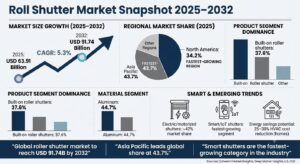
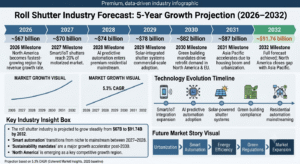
The global roll shutter industry has entered a period of sustained, accelerating growth, and the data behind it is impossible to ignore. The global roller shutter market is estimated to be valued at USD 63.91 billion in 2025 and is expected to reach USD 91.74 billion by 2032, exhibiting a compound annual growth rate (CAGR) of 5.3% from 2025 to 2032.
That figure, nearly $92 billion, represents a fundamental shift in how builders, homeowners, commercial property developers, and governments around the world think about building protection, energy efficiency, and security. The roll shutter is no longer a commodity product installed as an afterthought. It is becoming a primary building system, integrated into smart home ecosystems, green building certifications, and hurricane-resilience planning at the design stage.
This report documents that shift in full, covering market size and trajectory by region and segment, the five technology trends reshaping the industry, the competitive landscape, and where the largest growth opportunities will emerge through 2032.
Global Market Size and Regional Growth Analysis
The $92 Billion Trajectory
The roller shutter industry is not growing because of one trend, it is growing because four major global forces are converging simultaneously: rising security concerns, accelerating smart home adoption, tightening energy efficiency regulations, and the increasing frequency and severity of extreme weather events. Each driver is independent. Together, they create the conditions for sustained above-average growth through the remainder of the decade.
The market trend for roller shutters is driven by several factors, including the increasing demand for energy-efficient and secure building solutions, growing construction industry, and rising popularity of smart home technologies. Increasing demand for security and privacy solutions and rising construction activities globally are the major factors driving the growth of the global roller shutter market.
The rolling shutters market is transforming through automation, smart technology, and energy-efficient technology. There is also a great emphasis on automation by integrating it into rolling shutters, where manufacturers are going for smart systems that can be operated from anywhere through IoT and AI. This enhances convenience and security, as the operation and monitoring of shutters becomes easier. Energy-efficient designs are now growing with not only decreased operation costs but also compliance with green building standards.
North America: The Industry’s Most Significant Growth Story

By Material
North America, holding a share of 34.2% in 2025, is projected to display the fastest growth over the forecast period, driven by strong demand in both the commercial and industrial sectors.
The emphasis on enhanced security, energy efficiency, and storm protection, especially in regions prone to hurricanes and extreme weather such as the southern U.S. has been a key factor fueling market adoption. Technological advancements, including the integration of smart home automation systems and IoT-enabled roller shutters, have gained substantial traction among homeowners and property developers seeking automation and remote control capabilities.
North America’s position as the fastest-growing region is not a single-variable story. It reflects the collision of three simultaneous pressures unique to the North American market: a severe weather environment that is worsening year over year, a smart home adoption rate that is among the highest in the world, and a commercial and industrial sector that is rapidly upgrading aging building stock.
78% of newly built U.S. homes in 2024 incorporated smart home systems, including automated shutters. That penetration rate, nearly four in five new homes, signals that smart shutter integration has crossed from premium niche to mainstream expectation in North American residential construction.
By Material: Aluminum’s Structural Dominance
Asia Pacific: The Volume Engine
Asia Pacific leads the global market by share, and will continue to do so through 2032. The rapid urbanization, rising disposable incomes, and increasing construction activities in countries like China, India, and Southeast Asian nations have created a significant demand for roller shutters. The growing awareness about energy efficiency and the need for improved security in both residential and commercial buildings have further propelled the market growth in this region.
The Asia Pacific market is primarily volume-driven: high construction activity, large urban populations moving into new residential and commercial properties, and increasing security awareness. The premium smart-home segment is growing in Japan, South Korea, and Australia, but the core volume driver across the region remains new construction in China and India, where urbanization rates continue to add tens of millions of new urban residents annually.
Europe: The Regulatory Engine
Europe is the most mature roller shutter market in the world, and its growth story is largely regulatory in nature. Demand for these shutters is also driven by energy efficiency since insulated shutters reduce heating and cooling needs. In Europe, there’s a strong preference for products that meet green building standards and help reduce utility bills while enhancing thermal comfort in homes. Urbanization and increased housing density boost shutter installations in villas, apartments, and townhouses. In renovation markets like Germany, France, and Italy, people increasingly add shutters for both aesthetics and protection.
Germany and France together account for over 45% of Europe’s roller shutter market revenue. The EU’s increasingly stringent building energy performance directives are creating mandatory retrofit demand, property owners across the continent are being required, or financially incentivized, to upgrade building envelopes with products that meet minimum thermal performance standards. Roll shutters with insulated slat cores are among the most cost-effective compliance paths available.
Market Segmentation: What Is Actually Driving Sales
By Operation Type: The Motorized Majority
Electric (motorized) roller shutters lead the global market, accounting for approximately 42% of total revenue in 2025. The primary driver behind this dominance is the accelerating shift toward automation across commercial, industrial, and high-end residential infrastructure. Growing adoption of building management systems (BMS), smart warehouses, and automated retail outlets has significantly increased demand for tubular motor-driven shutters.
The electric segment held the biggest market share in 2023, equal to slightly more than 55% of the Roller Shutter Market revenue. The electric type’s growth is attributed to the increasing application of energy-efficient electric roller shutters in residential and commercial building constructions because of their preference in terms of convenience.
Manual shutters retain a significant share, particularly in price-sensitive markets across South and Southeast Asia, Africa, and Latin America, but the trajectory is clear. The fastest-growing sub-segment is smart/IoT-integrated shutters, driven by smart home adoption, energy management systems, and increasing demand for connected security infrastructure.
By Material: Aluminum’s Structural Dominance
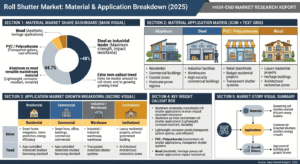
The aluminum segment is projected to dominate with a share of 44.7% in 2025.
Aluminum’s dominance reflects a combination of factors that are difficult for competing materials to overcome simultaneously: it is lightweight enough to be motorized efficiently, corrosion-resistant enough to withstand coastal and tropical climates, strong enough to meet hurricane and impact ratings, and versatile enough to be extruded into the complex profiles required for both foam-insulated slats and transparent safe-view applications.
Major Global Players
In logistics hubs and high-frequency operational environments, motorized shutters improve efficiency, reduce manual labor dependency, and enhance safety compliance, making them the preferred choice. The global expansion of logistics parks, manufacturing units, and export-processing zones has reinforced demand for galvanized and stainless steel shutters capable of withstanding high operational cycles and harsh environmental conditions.
The Five Technology Trends Reshaping the Industry
Trend 1: Smart Home Integration and the IoT Revolution
This is the most consequential trend reshaping the industry’s growth curve, and it is accelerating faster than most market forecasts anticipated even two years ago.
The growing adoption of smart home technologies is significantly influencing the electric roller shutter market, with consumers increasingly preferring connected and automated solutions that enhance convenience, security, and energy efficiency. Manufacturers like Somfy are introducing smart electric roller shutters that can be operated through mobile applications, giving users the ability to control them remotely from anywhere. These shutters can also be synced with virtual assistants such as Amazon Alexa, Google Assistant, and Apple HomeKit for hands-free, voice-activated operation.
For Talius, this trend is particularly significant. The Talius S.H.I.E.L.D. StormLock system can be networked and controlled remotely through a proprietary smartphone app, allowing property owners to secure their home, vacation property, or business from anywhere, regardless of their location when a storm develops.
The smart shutter represents something genuinely new in the building products industry: a security and protection system that functions proactively, not just reactively. A homeowner who is traveling when a hurricane warning is issued can close and lock every shutter on their property from a phone, thousands of miles away, in seconds. That capability, which did not exist at commercial scale five years ago, is now a standard feature expectation in the premium residential segment.
According to a report by the International Energy Agency, the smart home market is projected to grow to $174 billion by 2025, indicating a substantial opportunity for roller shutter manufacturers to tap into this expanding segment. As more consumers prioritize home automation for its convenience and security benefits, roller shutter motors are becoming an integral component of smart homes.
The integration roadmap extends well beyond basic remote control. Smart roller shutters with app and voice control are gaining popularity. Brands like ROMA and Griesser offer systems that work with KNX and Zigbee, allowing scheduled use and integration with modern home automation setups. Scheduled automation shutters that close at sunset, open at sunrise, and adjust for weather forecasts automatically is the next mainstream feature horizon.
Trend 2: Energy Efficiency as a Primary Purchase Driver
The energy efficiency narrative around roll shutters has historically been secondary, a supporting benefit behind security and storm protection. That is changing. As energy costs rise globally and green building regulations tighten, energy performance is increasingly the primary reason buyers in Europe and, increasingly, North America invest in roll shutter systems.
According to the U.S. Department of Energy, automated window coverings can reduce energy consumption by up to 25%, leading to a growing trend in smart home technologies.
Studies have shown that homes equipped with rolling shutters can experience energy savings of up to 30%. During the hot summer months, rolling shutters can block up to 70% of ambient heat from entering your home. This significant reduction in heat transfer means that your air conditioning system doesn’t have to work as hard, leading to lower electricity consumption and cost savings.
The thermal mechanism behind this performance is straightforward. When the roller shutters are lowered, an additional layer of air forms between the glass and the shutter. This is particularly important in buildings with large glazed areas, where a lack of adequate insulation can lead to significant energy losses. The full energy-saving potential of roller shutters is realised when they are integrated with home automation in winter, remaining raised during the day to make the most of the sun’s rays, and closing in the evening to minimise heat loss.
If your house has double-pane windows, adding the shutters will about double the insulation value of the windows. With single-pane windows, the percentage increase in efficiency will be significantly greater.
From a market dynamics standpoint, this energy performance story is doing something important: it is converting the roll shutter from a discretionary purchase into a financially justified investment with a calculable return. A product that reduces HVAC costs by 25–30% annually has a measurable payback period which changes the sales conversation from “protection feature” to “energy infrastructure investment.”
Trend 3: Climate-Driven Demand Extreme Weather as a Market Accelerator
The relationship between worsening extreme weather and roll shutter demand is direct, measurable, and accelerating. Every major hurricane season, every catastrophic hailstorm, and every major flooding event produces a measurable spike in shutter inquiries, quotations, and installations in the affected regions, and a sustained uplift in adjacent regions where residents draw their own risk conclusions.
Increasing climate variability and frequent extreme weather events lead to more homeowners adopting shutters that provide insulation and storm protection, keeping homes safe throughout the year.
Talius storm roll shutters exceeded performance expectations during in-house testing for impact resistance and deflection under simulated hurricane force winds. Third-party testing will now certify its strength to ensure that Talius roll shutters will protect property during a hurricane.
Talius roll shutters are tested to withstand hurricane force winds up to 88 mph and deflect the impact of flying debris at 30 mph.
In North America specifically, the storm protection driver is intensifying on two fronts simultaneously. Hurricane exposure is worsening along the Gulf and Atlantic coasts. And the 2024 and 2025 disaster seasons demonstrated that catastrophic weather events are now reaching inland communities that previously had no significant storm protection infrastructure at all, expanding the total addressable market geographically beyond its traditional coastal footprint.
North America’s emphasis on enhanced security, energy efficiency, and storm protection especially in regions prone to hurricanes and extreme weather such as the southern U.S. has been a key factor fueling market adoption. Rollac Shutters, a U.S.-based company, offers hurricane-rated roller shutters that comply with Miami-Dade County building codes. Miami-Dade compliance, the most stringent hurricane impact standard in North America is becoming a baseline expectation in the premium residential segment across the entire Gulf and Atlantic coast, not just South Florida.
Trend 4: Commercial and E-Commerce Warehouse Expansion
Rising smart and IoT integration, growing demand for customization, and growth in e-commerce and warehousing are significant trends in the electric roller shutter market.
The e-commerce buildout of the last decade has created an enormous secondary demand engine for industrial roll shutter systems that is almost entirely separate from the residential and commercial security drivers. Fulfillment centers, last-mile logistics hubs, cold storage facilities, and data center construction all require high-cycle, high-durability roll shutter systems for loading dock management, thermal separation, and access control.
The global expansion of logistics parks, manufacturing units, and export-processing zones has reinforced demand for galvanized and stainless steel shutters capable of withstanding high operational cycles and harsh environmental conditions. Additionally, steel remains cost-competitive for large industrial door installations, further supporting its widespread adoption.
Fire-rated roll shutters represent a specific growth sub-segment within this trend. Recent developments include the launch of fire-rated roller shutters by leading manufacturers to meet growing safety regulations. In pharmaceutical manufacturing, food processing, and data center environments, fire-rated compartmentalization using roll shutters is increasingly a regulatory requirement rather than an optional upgrade creating a captive and recurring demand base.
Trend 5: Customization and Design Integration
Personalization trends are rising, with 40% of buyers seeking shutters tailored to aesthetics and insulation needs.
The commoditization era of roll shutters when a beige aluminum box above a window was the only option is over. The market in 2025 and beyond is defined by deep customization: color-matched profiles, integrated architectural housing, transparent polycarbonate options, and a range of slat widths and finishes that allow shutters to disappear into or enhance a building’s visual design.
Customers expect to control their shutters remotely via smartphone apps or smart assistants like Amazon Alexa and Google Home. The desire for greater convenience is fueling the integration of smart technology into roller shutters. Customers are increasingly seeking personalized solutions that meet their specific aesthetic and functional requirements. This includes options for particular colors, insulation levels for noise reduction, and solar protection, making customization a significant trend in the market.
For manufacturers, customization creates both an opportunity and a manufacturing challenge. The opportunity is margin custom products command significantly higher prices than commodity products. The challenge is that deep customization requires flexible manufacturing infrastructure, precise measurement and installation capabilities, and supply chains capable of producing small-batch, made-to-specification orders economically.
Competitive Landscape
Major Global Players
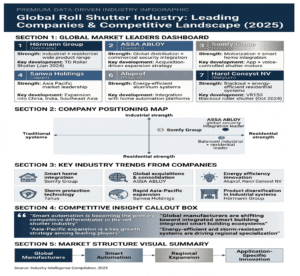
The major players in the global roller shutter market include Hormann Group, ASSA ABLOY, Alulux GmbH, Somfy Group, Sanwa Holdings Corporation, Heroal, Stella Group, Aluprof SA, Novoferm GmbH, SKB Shutters Corporation BHD, Bunka Shutter Co., Ltd., Mirage Doors Pty Ltd, Thompsons Roller Shutters Pty Ltd, and Rax Door, among others.
What This Report Means for Industry Stakeholders
AI-driven predictive automation
Talius’s Competitive Position
Talius occupies a differentiated position in the North American market that is directly aligned with the two fastest-growing demand drivers in the region: hurricane and storm protection, and smart home automation. For over 40 years, Talius products have protected schools, commercial, and residential buildings from intruders and vandalism. The new S.H.I.E.L.D. StormLock roll shutters protect buildings against the impact of storms and hurricanes, using extruded profiles in combination with proven proprietary Talius technologies to ensure the highest level of building protection.
That combination four decades of manufacturing credibility with a newly launched smart remote-deployment system purpose-built for hurricane scenarios places Talius at the intersection of the market’s two highest-growth segments in its primary geographic market. As North America becomes the fastest-growing region in the global roller shutter industry, manufacturers with established North American distribution, installer networks, and brand recognition are in the strongest competitive position to capture that growth.
Market Drivers, Restraints, and Opportunities
Growth Drivers
Extreme weather acceleration. The frequency of billion-dollar weather events in North America has nearly tripled over the past 20 years. Every major storm season expands the pool of homeowners and property managers who have personally experienced property damage and are actively seeking permanent protection solutions.
Smart home mainstream adoption. 78% of newly built U.S. homes in 2024 incorporated smart home systems, including automated shutters. As smart home capability becomes a standard rather than premium feature in new construction, the installation of motorized, app-connected shutters at the construction stage rather than the retrofit stage becomes the norm, expanding the addressable market and reducing installation friction.
Energy regulation tightening globally. Building energy performance standards are becoming more stringent in North America, Europe, and increasingly in Asia Pacific. Roll shutters with insulated slat cores are one of the most cost-effective paths to improved building envelope performance, making them a natural beneficiary of regulatory mandates.
Construction growth in emerging markets. Urbanization in India, Southeast Asia, and Sub-Saharan Africa is creating new construction markets where roll shutter adoption is at early stages, meaning there is decade-long runway for penetration growth without market saturation.
Restraints
High upfront installation costs. High upfront purchase and installation costs discourage homeowners from choosing roller shutters, especially in housing markets that are sensitive to price, where cheaper shading or security options are available. Installation complexity further discourages retrofitting in older buildings.
Building codes and HOA restrictions. Strict building codes, design rules, and homeowner association guidelines in many areas restrict the use of exterior shutters, especially in heritage zones or modern residential complexes where aesthetics and uniformity are prioritized.
Raw material price volatility. U.S. tariffs on Chinese imports, including raw materials, have increased manufacturing costs by 10–15%, affecting price-sensitive markets. Aluminum and steel pricing volatility creates margin pressure for manufacturers without vertically integrated supply chains.
Opportunities
Retrofit market in aging North American housing stock. The majority of homes in the United States and Canada were built before the current era of motorized roll shutters. The retrofit opportunity, installing systems in existing homes rather than only new construction is enormous and largely untapped outside of hurricane-prone coastal markets.
Insurance incentive expansion. In Florida and select other states, installation of certified hurricane shutters already qualifies for insurance premium discounts. As insurers respond to escalating climate loss data by pricing storm risk more accurately, the financial incentive to install certified protection systems will expand geographically, creating a new demand driver that operates independently of consumer awareness.
Solar-integrated shutter systems. The integration of solar panels into roller shutters to generate electricity is an emerging trend, offering energy independence and cost savings. A roll shutter that simultaneously provides storm protection, thermal insulation, and solar energy generation occupies a uniquely compelling position in the market, and represents the next generation of product differentiation for manufacturers willing to invest in the technology.
AI-driven predictive automation. By 2030, smart shutters integrated with AI for predictive maintenance will dominate high-end markets. Systems that automatically close before a detected weather threat, open to optimize passive solar heating, and self-diagnose maintenance needs represent the product roadmap that will separate premium manufacturers from commodity suppliers over the next decade.
What This Report Means for Industry Stakeholders
For architects and building designers: Roll shutter integration at the design stage rather than as a retrofit is becoming the expectation in premium residential and commercial construction. Specifying motorized, insulated systems that are compatible with smart home ecosystems and meet hurricane-impact ratings positions a project at the leading edge of both client expectation and building code compliance.
For real estate developers: The North American residential market is the fastest-growing region in the global roll shutter industry. Buyers increasingly expect automated window protection as a standard feature in coastal and weather-exposed markets, not an optional upgrade. Incorporating roll shutter systems into project specifications adds measurable property value and reduces the insurance exposure of properties in storm-prone regions.
For insurance professionals: The expansion of certified storm shutter installations across North America will increasingly intersect with insurance underwriting models. Products that meet Miami-Dade or equivalent hurricane-impact certifications provide quantifiable risk reduction and the insurance industry’s pricing response to that risk reduction will become a significant demand driver independent of consumer awareness campaigns.
For contractors and installers: The retrofit opportunity in North American housing stock represents the largest near-term growth segment. Homeowners who experienced property damage during the 2024 and 2025 storm seasons, or who have revised their risk perception in response to news coverage of those events, represent an active, high-conversion prospect pool particularly in markets outside the traditional coastal installation footprint.
Bottom Line
The global roll shutter industry in 2026 is not the same industry it was a decade ago and it will not be the same industry in 2032 that it is today. The convergence of smart home technology, energy efficiency mandates, extreme weather acceleration, and e-commerce-driven construction is transforming a product that was once a commodity into a sophisticated building system at the center of three of the most important trends in construction and property management.
The global roller shutter market at USD 63.91 billion in 2025, growing to USD 91.74 billion by 2032, with North America projected to be the fastest-growing region, represents one of the most compelling growth stories in the building products sector underpinned by real structural demand, not speculative expansion.
The manufacturers, installers, and distributors who recognize this inflection point and position their businesses for the next phase of growth in smart automation, in climate-driven storm protection, in energy-performance retrofits will be the ones who capture a disproportionate share of a market that is growing by nearly $4 billion per year.
The window is open. The question is whether the industry moves through it before it closes.