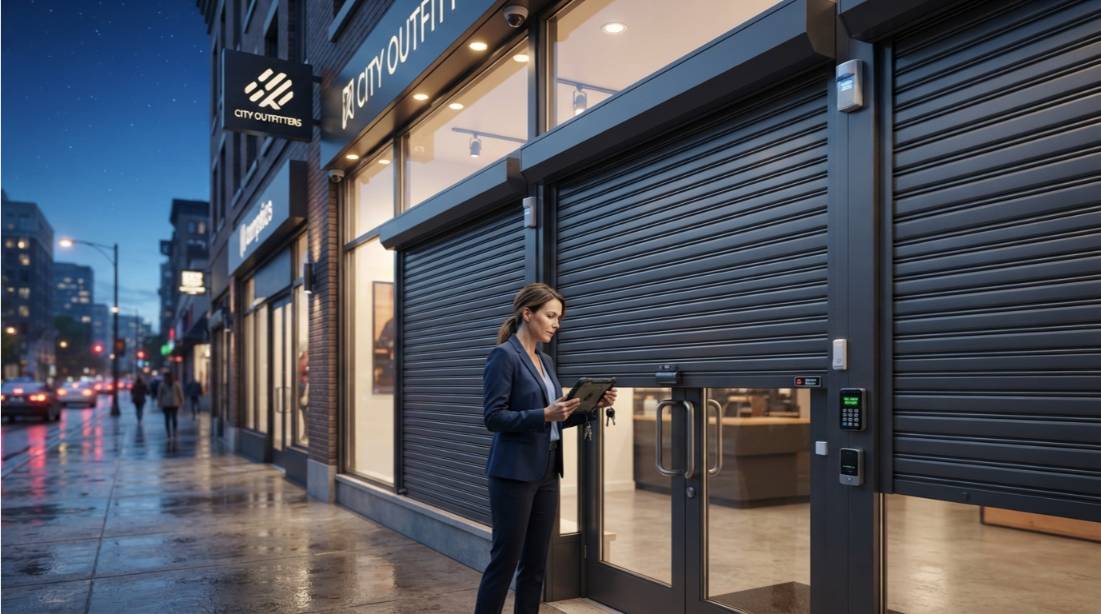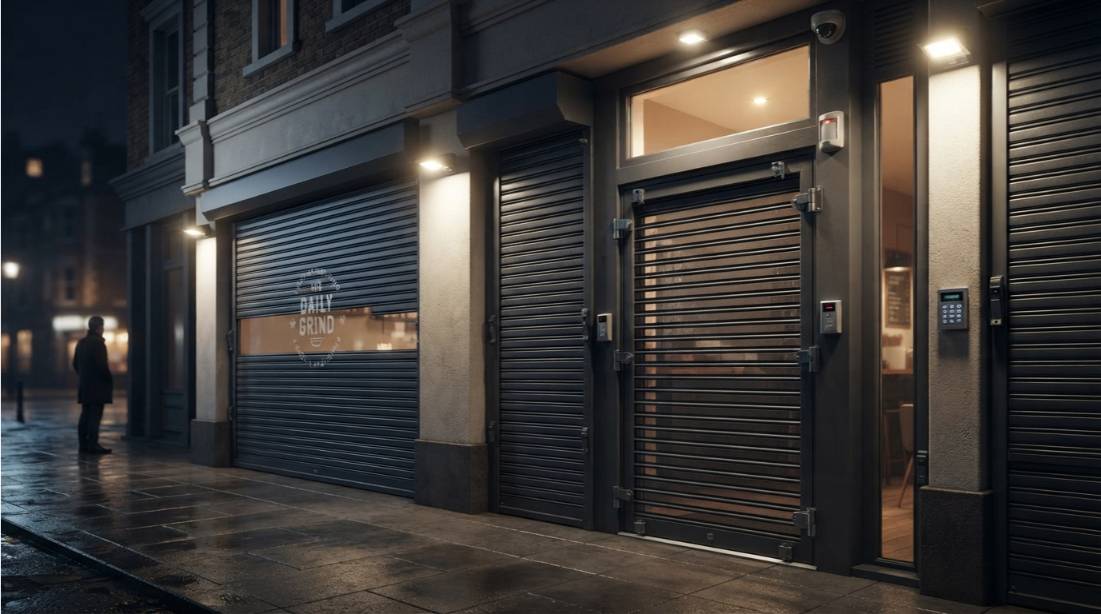
Security shutters can deter break-ins by making doors and windows harder to access, increasing the time and effort needed for forced entry, and visibly showing that a property is protected. They are not a guarantee against every attempted burglary, but they can make a building a less attractive target for opportunistic criminals. When combined with alarms, cameras, strong locks, and other security measures, security shutters can form an effective layer of physical security.
Do Security Shutters Really Deter Break-Ins?
Yes, security shutters can have a meaningful deterrent effect.
Burglars generally want access to a property without attracting attention or spending more time than necessary at the scene. A protected opening presents a different challenge from an exposed glass door or window. Instead of simply breaking glass and reaching inside, an intruder may first have to overcome a solid shutter, its locking mechanisms, tracks, and other security components.
That added difficulty matters. Security shutters create both a visible security measure and a physical obstacle. Research and security guidance around roller shutters consistently point to the value of making unauthorized access more difficult, particularly where shutters cover vulnerable windows, doors, and commercial openings.
The key point, however, is that deterrence is not the same as making a property completely burglar-proof. A determined criminal may still attempt to defeat a security system. The purpose of a well-designed shutter is to discourage opportunistic attempts, delay forced entry, and add another layer of protection.
How Security Shutters Create a Physical Barrier
One of the biggest advantages of security shutters is straightforward: they put a physical barrier between an intruder and the protected opening.
Windows and doors are often among the most vulnerable entry points in a building. Large areas of glass can be particularly attractive to criminals because breaking through them may provide quick access to the interior. Security shutters can cover these openings when a property is closed, creating a reinforced layer between the outside environment and the building.
This is particularly useful for businesses that may be unattended overnight. Once employees leave, there may be no one inside to immediately notice suspicious activity. A properly secured shutter can make an attempted break-in more complicated before an intruder even reaches the underlying window or door.
Rather than relying entirely on detection, the shutter provides physical security at the point where entry could occur.
Making Forced Entry More Difficult
The effectiveness of a security shutter comes down partly to how much effort an intruder has to expend to get through it.
A basic window may be smashed in seconds. A properly designed security shutter, on the other hand, is intended to resist attempts to force the protected opening. Depending on the design, construction, locking system, and installation, it can make prying, lifting, or otherwise defeating the barrier more difficult.
This is where forced-entry resistance becomes important.
Security shutters should not be marketed as an impenetrable wall. Instead, their value lies in increasing the difficulty, time, and risk associated with gaining unauthorized access. Security-focused shutter systems may incorporate strong materials, interlocking components, secure tracks, and dedicated locking mechanisms to strengthen the overall barrier.
For a criminal looking for a quick opportunity, encountering that additional resistance may be enough to move on.
Why Visible Security Measures Can Discourage Criminals
Security does not always have to be hidden to be effective.
A clearly visible security shutter sends an immediate message: this property has taken steps to protect its openings. For opportunistic criminals, that can change the perceived risk of targeting the building.
This is one reason crime deterrence is such an important part of physical security. Lighting, cameras, alarms, and signage can all communicate that a property is monitored. Security shutters add something different because they are not simply a warning or detection device. They are an actual physical obstacle.
When closed over a storefront or other vulnerable opening, shutters can make the property look considerably more difficult to enter than an unprotected glass frontage. Security companies commonly describe this combination of visibility and physical resistance as an important part of the deterrent effect.
How Security Roller Shutters Protect Windows and Doors
Security roller shutters are designed to provide protection over openings such as windows, doors, storefronts, and other access points.
When closed, the shutter forms a barrier across the opening. Depending on the product, the shutter may consist of interlocking slats or other reinforced components that move along tracks and lock into position.
That makes security roller shutters particularly useful for commercial properties with large areas of exposed glass. Retail stores, offices, warehouses, and other businesses may have windows or doors that are difficult to protect with conventional security measures alone.
It is worth remembering that not all roller shutters are designed for the same purpose. Some are primarily intended for shading, privacy, weather protection, or insulation. A security application requires consideration of construction, locking mechanisms, installation, and the level of protection required.
The Importance of Locking Mechanisms and Security Bolts
A strong shutter is only as effective as the system holding it in place.
Locking mechanisms play an important role because they prevent an intruder from simply lifting or moving the shutter out of the way. Depending on the design, additional security features may include security bolts, reinforced guides, secure fasteners, and other components intended to improve resistance against tampering.
The surrounding frame and installation are equally important. If a shutter is strong but poorly fitted, the overall security of the opening may be compromised.
For this reason, choosing burglar-resistant shutters should involve more than looking at the appearance of the product. Property owners should consider how the complete system performs, including the shutter curtain, tracks, locks, frame, and installation.
EHRET, for example, highlights the importance of matching the shutter model with appropriate frames, fittings, security bolts, hinges, and locking components when increased burglary protection is required.
Are Security Shutters Better Than Alarms or Cameras?
It is not really a matter of choosing security shutters instead of an alarm or camera system.
Each security measure has a different job.
Alarm systems can detect suspicious activity and alert occupants, security personnel, or monitoring services. Surveillance cameras can provide visibility, help verify an incident, and potentially provide useful evidence. Security shutters, meanwhile, provide a physical obstacle at the building’s vulnerable entry points.
That difference is important.
A camera can record someone breaking a window, but it does not physically stop the window from being broken. An alarm can alert you after an intrusion is detected, but it does not necessarily prevent the intruder from reaching the building’s interior. A security shutter can make the initial physical intrusion more difficult.
Used together, these measures can provide a much stronger security strategy.
Why Layered Security Matters
The most sensible approach to burglary protection is usually layered security.
Instead of expecting one product to solve every security problem, property owners can combine several measures that work at different stages of a potential intrusion.
For example, strong doors and locks can protect access points, security shutters can create a physical barrier, surveillance cameras can monitor the property, and alarm systems can provide detection and notification. Smart security systems can add remote control and monitoring capabilities where appropriate.
This creates multiple obstacles for an intruder: discourage the attempt, make entry more difficult, detect suspicious activity, and give the property owner or security team an opportunity to respond.
Security shutters therefore work particularly well as part of a broader strategy rather than as a standalone solution.
Can Security Shutters Help With Vandalism and Theft?
Break-ins are not the only concern for exposed windows and doors.
Businesses can also face vandalism, property damage, and attempts to steal merchandise through storefront glass. Even when an intruder does not successfully enter a building, damaged windows and doors can result in expensive repairs and business disruption.
Security shutters can provide vandalism protection by placing a physical layer over vulnerable glass and openings. For retailers, this can be particularly valuable after closing time when valuable inventory is visible but the premises are unattended.
A shutter can also support theft prevention by making it harder to reach merchandise through a protected opening. Roll-A-Shield, for example, describes storefront shutters as a way to cover windows and doors and provide a physical barrier against smash-and-grab attempts.
Do Automated Security Shutters Improve Protection?
Automation can make security shutters easier to use consistently.
For a business owner, manually securing every opening at the end of the day may become inconvenient, particularly across multiple windows or doors. Motorized shutters can simplify the process and help ensure that security measures are actually used when the property is closed.
Modern systems can also integrate with smart security systems, depending on the installation and control technology. Remote operation and integration with other security equipment may provide additional convenience.
However, automation should not be confused with physical security. A motorized shutter still needs appropriate construction, secure locking, reliable components, and professional installation. The underlying physical barrier remains central to its role in burglary protection.
Are Security Shutters Suitable for Homes and Businesses?
Security shutters can be used in both residential and commercial environments, although the requirements can be very different.
At home, homeowners may want additional protection for windows, patio doors, garages, or other vulnerable openings. Privacy and protection when the property is empty can also be useful.
For businesses, the need can be more obvious. Retail storefronts may have large glass windows and doors that expose merchandise after hours. Offices, commercial buildings, and other premises may also have vulnerable access points that need protection outside normal operating hours.
In both situations, the important question is not simply whether shutters are installed. It is whether the selected system is appropriate for the particular opening, threat level, and security requirements.
What Makes a Security Shutter Effective Against Break-Ins?
Not every shutter offers the same level of protection. When evaluating security shutters, consider the complete system rather than focusing on one feature.
Look at the construction and materials, the shutter’s forced-entry resistance, the quality of its locking mechanisms, the strength of its tracks and frame, and whether it is specifically intended for security applications.
Professional installation also matters. A security shutter needs to be correctly fitted so that the barrier, guides, locks, and surrounding structure work together.
Most importantly, consider the building’s actual vulnerable entry points. A shutter may provide excellent protection at one opening while another unprotected door or window remains an easy route inside.
Common Misconceptions About Security Shutters
One common misconception is that security shutters make a property completely burglar-proof. They do not. No single security product can guarantee that a determined criminal will never attempt an intrusion.
Another misconception is that an alarm makes physical protection unnecessary. In reality, detection and physical resistance serve different purposes.
It is also a mistake to assume that all roller shutters offer the same level of protection. Security performance depends on design, materials, locking mechanisms, installation, and the application for which the shutter was selected.
The goal should be to make unauthorized access more difficult and less attractive while creating multiple layers of protection around the property.
How to Use Security Shutters as Part of a Complete Security Strategy
Start by identifying the areas most likely to be targeted. Large storefront windows, glass doors, rear entrances, easily accessible windows, and other vulnerable entry points deserve particular attention.
From there, choose security shutters appropriate to those openings and have them professionally installed. Make sure locks and other security components are regularly checked and kept in working condition.
Then consider what happens if someone still attempts to approach the building. Surveillance cameras can provide monitoring, alarm systems can provide detection, and smart security systems can offer additional control or notifications.
This approach is more effective than relying on a single product. The shutter acts as the physical barrier, while other security measures help detect, monitor, and respond to potential threats.
FAQs About Security Shutters and Break-Ins
Do security shutters actually deter burglars?
Yes. Security shutters can deter break-ins by visibly strengthening a property and creating a physical obstacle that makes unauthorized access more difficult and time-consuming. Their effectiveness depends on the shutter’s construction, locking system, installation, and how well it addresses the property’s vulnerable entry points.
Can security shutters prevent forced entry?
They can make forced entry substantially more difficult, but they cannot guarantee that a determined intruder will be unable to gain access. The purpose of forced-entry-resistant shutters is to increase the physical resistance and delay an attempted intrusion.
Are security roller shutters better than regular roller shutters?
For security purposes, a shutter specifically designed for physical protection is generally more appropriate than a shutter intended primarily for shading or privacy. Construction, locking mechanisms, tracks, and installation should all be considered.
Should I use security shutters with an alarm system?
Yes. Security shutters and alarm systems perform different functions and can complement each other. The shutter provides physical resistance, while the alarm helps detect and report suspicious activity.
Are automated security shutters secure?
Automation can make shutters easier to operate consistently and may allow integration with smart security systems. However, the physical construction, locking mechanisms, installation, and suitability of the shutter remain the most important considerations for security.
Bottom Line
Security shutters can be an effective way to deter break-ins because they combine visible crime deterrence with a genuine physical barrier. By protecting vulnerable windows and doors, increasing resistance to forced entry, and adding another layer between criminals and the property, they can make a target less appealing. For the strongest burglary protection, security shutters should be combined with alarms, surveillance cameras, quality locks, and other layered security measures.