A glass storefront helps businesses look inviting, showcase products, and bring natural light into the space. After closing, however, those same windows and doors can become vulnerable entry points. Break-ins, smash-and-grab theft, vandalism, and property damage can happen when no one is around. The good news is that businesses can combine physical barriers, reinforced glass, alarms, cameras, and other security measures to create effective after-hours protection.
Why Glass Storefronts Are Vulnerable After Business Hours
A glass storefront is valuable for attracting customers, but its large windows and glass doors can also create security challenges. Unlike a solid wall, storefront glass can be targeted by someone attempting to gain quick access to a business.
The risk can become more noticeable after business hours. Once employees leave, there may be no one nearby to respond immediately to suspicious activity. A criminal looking for an easy target may take advantage of an exposed retail storefront, particularly if valuable products are clearly visible from outside.
A typical storefront may have several vulnerable entry points, including front windows, doors, side entrances, and other accessible openings. That’s why effective storefront security should look at the entire property rather than focusing on one window or door.
Common threats include break-ins, forced entry, smash-and-grab theft, vandalism, and property damage. Businesses carrying expensive electronics, jewelry, tools, alcohol, or other high-value inventory may have an even greater reason to strengthen their protection.
7 Ways to Secure a Glass Storefront After Business Hours
There isn’t one security product that works for every business. The right approach depends on the property’s design, location, operating hours, merchandise, and potential risks. In many cases, combining several security measures creates a stronger defense.
1. Install Security Shutters Over Storefront Glass
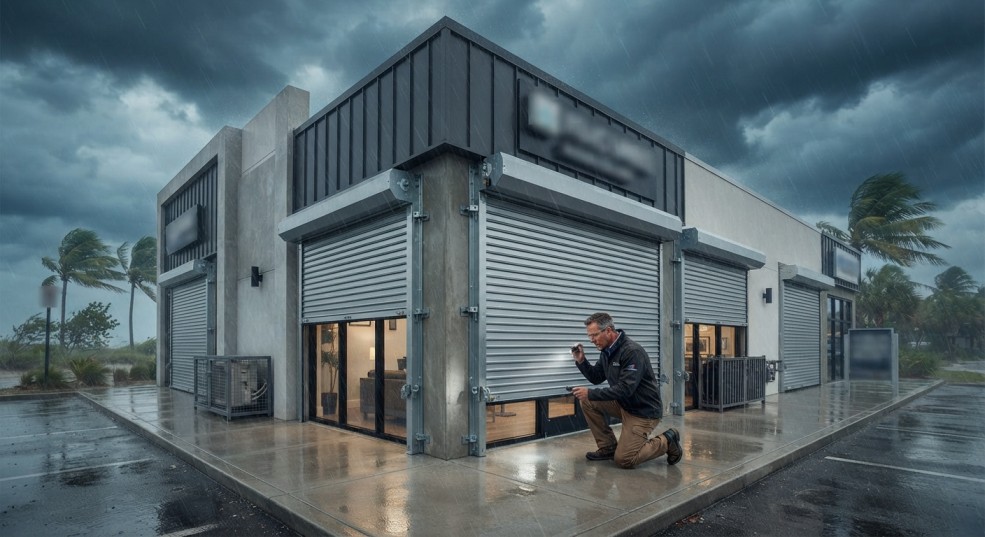
One of the most direct ways to improve after-hours protection is to install security shutters over exposed glass.
Unlike security systems that detect activity, shutters act as a physical barrier. When closed, they can cover storefront windows and doors, making it more difficult for someone to directly access the glass.
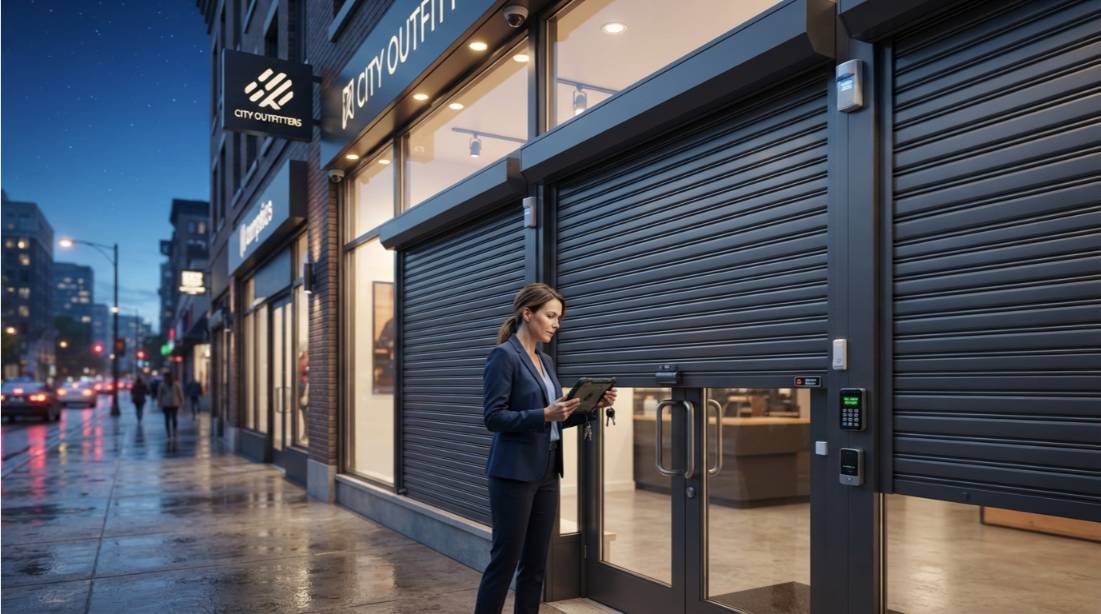
Roll-down shutters are particularly useful for commercial properties because they can be raised during business hours and lowered when the business closes. This allows the storefront to remain open and visually appealing during the day while providing an additional layer of physical security overnight.
For retailers concerned about merchandise protection, this can be especially useful. Instead of leaving expensive products behind exposed glass, the business can secure the entire opening with a purpose-designed barrier.
The exact level of protection depends on the shutter’s construction, configuration, installation, and intended application. For businesses evaluating this option, it’s important to choose a system designed for their particular storefront rather than assuming every shutter provides the same level of forced-entry resistance.
2. Use Security Window Film for Additional Glass Protection
Another option is security window film. Applied to existing glass, security film can help hold broken glass together after an impact and may make it more difficult for an intruder to immediately pass through a damaged pane.
This can be useful for businesses that want to reinforce existing storefront glass without completely changing the glazing system.
However, security film and shutters serve different purposes. Film reinforces the glass itself, while a shutter creates a separate physical barrier over the opening. Depending on the property’s risk level, businesses may choose one solution or combine multiple forms of protection.
For higher-risk locations, it’s worth looking at the entire storefront rather than relying on a single protective measure.
3. Consider Laminated Security Glass or Polycarbonate Glazing
Replacing standard glass with a more robust glazing option can provide another layer of protection.
Laminated security glass is constructed using multiple layers with an interlayer between them. When the glass is damaged, the interlayer can help keep the broken pieces together rather than allowing the pane to collapse immediately.
Another option in certain commercial applications is polycarbonate glazing. Polycarbonate is known for its high impact resistance and can be considered where a business needs a different approach to protecting vulnerable openings.
The appropriate material depends on factors such as the size of the opening, design requirements, security objectives, and building configuration. Businesses should review the performance specifications of any glazing product before making a decision.
4. Secure Glass Doors and Other Access Points
Protecting storefront windows won’t do much good if the doors remain an easy way inside.
Glass doors should be considered as part of the same security strategy. Depending on the property, businesses may use stronger locks, reinforced hardware, digital locks, or access control systems to manage who can enter.
It’s also important to inspect secondary entrances. Rear doors, side entrances, loading areas, and less-visible access points can sometimes receive less attention than the main storefront.
A proper security assessment should identify every accessible opening and determine which areas need additional protection.
5. Install Surveillance Cameras and Remote Monitoring
Surveillance cameras play an important role in modern commercial security. Strategically positioned cameras can monitor storefronts, entrances, parking areas, and other vulnerable locations.
Cameras can also contribute to crime deterrence. Visible security equipment may make a property less appealing to someone looking for an easy target.
For businesses that want protection beyond simply recording footage, remote monitoring can provide additional oversight. Depending on the service, alerts can be sent when suspicious activity or movement is detected.
Still, cameras have a limitation: they don’t physically prevent someone from breaking a window or forcing a door. They are most effective when combined with physical barriers and other security measures.
6. Add Alarm Systems and Security Lighting
Alarm systems can provide another important layer of after-hours protection. Door and window sensors, motion detection, and monitored alarms can alert a business owner or security provider when unusual activity occurs.
Security lighting is equally useful. Well-lit entrances and storefront areas can reduce dark hiding places and make suspicious activity easier to see. Lighting can also improve the visibility of surveillance cameras.
Together, alarms and lighting contribute to a broader security strategy. The goal isn’t simply to react to an incident but to make the property less attractive and more difficult to target.
7. Build a Layered Security Strategy
The strongest after-hours security plans usually involve several complementary measures rather than one standalone product.
For example, security shutters can provide a physical barrier, while laminated glass or security film can reinforce the glass underneath. Cameras can monitor activity, alarm systems can detect unauthorized access, security lighting can improve visibility, and access control can restrict entry.
This is the basic idea behind layered security. Each measure addresses a different part of the problem.
If one layer is bypassed, another may still provide protection or trigger a response. For a retail business with valuable merchandise, this approach can provide a more comprehensive form of commercial security.
How to Choose the Right Storefront Security Measures
Every commercial property has different security requirements. A small shop in a quiet area may face different risks from a jewelry store, pharmacy, electronics retailer, or business located in a high-traffic urban area.
Start with a security assessment. Look at the property’s location, storefront design, lighting, surrounding environment, operating hours, previous incidents, and accessibility of windows and doors.
Then consider what needs protection. Businesses with high-value inventory may need stronger physical barriers than properties with relatively low-value merchandise. The potential cost of stolen products, damaged equipment, repairs, and business disruption should all be considered.
There’s also a practical design consideration: security shouldn’t necessarily mean sacrificing the appearance of the storefront.
During business hours, retailers often want excellent visibility, attractive curb appeal, and plenty of natural light. A well-planned system can provide an open, welcoming storefront during operating hours while allowing the property to be secured after closing.
What Is the Best Security Option for a Glass Storefront?
There is no universal answer because different security products solve different problems.
Security shutters provide a physical barrier. Security window film can reinforce existing glass. Laminated security glass and polycarbonate glazing can provide increased resistance to impacts in appropriate applications. Security bars and grilles can also provide a physical barrier, although businesses need to consider how they affect appearance, access, and visibility.
Meanwhile, cameras, alarm systems, security lighting, digital locks, and access control focus more on detection, deterrence, or controlled access.
For many retailers, the best solution isn’t choosing one product. It’s selecting a combination that addresses the property’s specific vulnerabilities.
Should You Install Security Shutters on a Retail Storefront?
Security shutters can be particularly useful for businesses with large exposed windows, glass doors, valuable merchandise, or extended periods when the premises are unoccupied.
They provide a straightforward distinction between daytime and nighttime use. During operating hours, customers can see the products and the storefront remains open and inviting. Once the business closes, the shutters can be deployed to create an additional physical barrier.
For businesses considering automated security shutters, automation can also make the closing process more convenient and consistent. Instead of relying entirely on staff to manually secure every opening, an automated system can simplify operation.
The suitability of any shutter depends on the storefront’s dimensions, design, security requirements, and other site-specific factors.
Common Mistakes to Avoid When Securing a Glass Storefront
One common mistake is relying exclusively on cameras. Surveillance is valuable, but a camera cannot physically stop an intruder from breaking through glass.
Another is securing the main storefront while overlooking secondary entrances. Criminals may look for the least protected access point rather than the most obvious one.
Businesses should also avoid choosing security products based solely on appearance or price. Performance specifications, installation requirements, and suitability for the property are equally important.
Finally, don’t overlook the value of professional installation. A high-quality security product may not perform as intended if it isn’t correctly measured, fitted, and installed.
Why Professional Installation Matters
Professional installation is particularly important for security shutters, reinforced glazing, access control systems, and other products where fitting directly affects performance.
A professional can assess the opening, identify installation requirements, and ensure the system is configured appropriately for the property.
Businesses should also keep product specifications, invoices, warranties, installation records, and other relevant documentation. These records can be useful for maintenance and future security assessments.
Regular inspection is important too. Locks, shutters, alarms, cameras, and other security features should be checked periodically to make sure they remain operational.
After-Hours Storefront Security Checklist
Before leaving for the night, staff should confirm that all entrances are locked, security shutters are fully closed where installed, alarm systems are activated, cameras are operating, and security lighting is functioning.
It’s also worth checking that valuable merchandise isn’t unnecessarily visible through exposed windows and that secondary entrances are secure.
These simple closing procedures, combined with appropriate physical and electronic protection, can significantly strengthen a property’s overall security routine.
Frequently Asked Questions
How can I protect my glass storefront after business hours?
A combination of physical and electronic security measures can provide effective protection. Options include security shutters, reinforced glass, security window film, cameras, alarm systems, security lighting, and access control.
Are security shutters effective against smash-and-grab attacks?
Security shutters can create an additional physical barrier over storefront glass and may increase resistance to attempted forced entry. However, performance varies by product and installation, so businesses should select a system designed for their specific security requirements.
Are roll-down shutters suitable for retail storefronts?
Roll-down shutters can be suitable for many retail applications because they can protect exposed openings after closing while remaining out of the way during business hours. The appropriate system depends on the storefront’s design and security needs.
Is security window film enough to secure a storefront?
Security film can reinforce existing glass, but it doesn’t provide the same type of physical barrier as a shutter. Businesses with greater security concerns may consider combining reinforced glass or film with shutters and other security measures.
What is better for storefront security: cameras or shutters?
They perform different functions. Cameras provide monitoring and evidence, while shutters provide physical protection. Using both as part of a layered security strategy can address more aspects of storefront security.
How do I secure glass doors after closing?
Start with strong locking hardware and consider digital locks or access control where appropriate. Reinforced glazing, security film, alarms, cameras, and security shutters can provide additional protection depending on the property’s requirements.
Can storefront security affect visibility and curb appeal?
It can, depending on the security product. Businesses should consider solutions that provide strong after-hours protection without unnecessarily compromising visibility, natural light, or curb appeal during operating hours.
Final Thoughts
Securing a glass storefront after business hours requires more than installing a camera or locking the front door. A combination of physical barriers, reinforced glazing, alarms, lighting, surveillance, and access control can create stronger protection. Security shutters are especially useful when a business needs an additional physical barrier over vulnerable glass. Start with a security assessment, identify your property’s risks, and choose professionally installed solutions suited to the storefront.