Awning size is the decision most people make last , after they’ve fallen for a colour or a fabric , and it’s the one that matters most. Get it wrong and you’ll either be squinting into the afternoon sun from your favourite chair, or staring at a structure that dwarfs your exterior wall. Here’s how to measure properly, understand what the numbers mean, and get it right before anything goes on order.
Why Getting Awning Size Right Matters
A retractable awning that’s too small is more frustrating than no awning at all. You get a strip of shade over the back half of the patio while the furniture, the outdoor entertaining area, and anyone sitting in it bakes in direct sun. The whole point of installing one, outdoor comfort, extended time outside, genuine sun protection, doesn’t land if the coverage area falls short of where people actually sit.
Go too large, and you’re dealing with a different set of problems. An oversized patio awning puts unnecessary load on the exterior wall, can create roofline clearance issues depending on where it’s mounted, and often looks visually out of scale with the building. Neither extreme is a good outcome.
The right awning size delivers shade coverage across the full activity zone, sits proportionally on the wall, and works within the structural constraints of the space. For homes with non-standard patio dimensions or unusual wall configurations, a custom awning is often the smarter route than trying to make a standard size fit where it doesn’t quite belong.
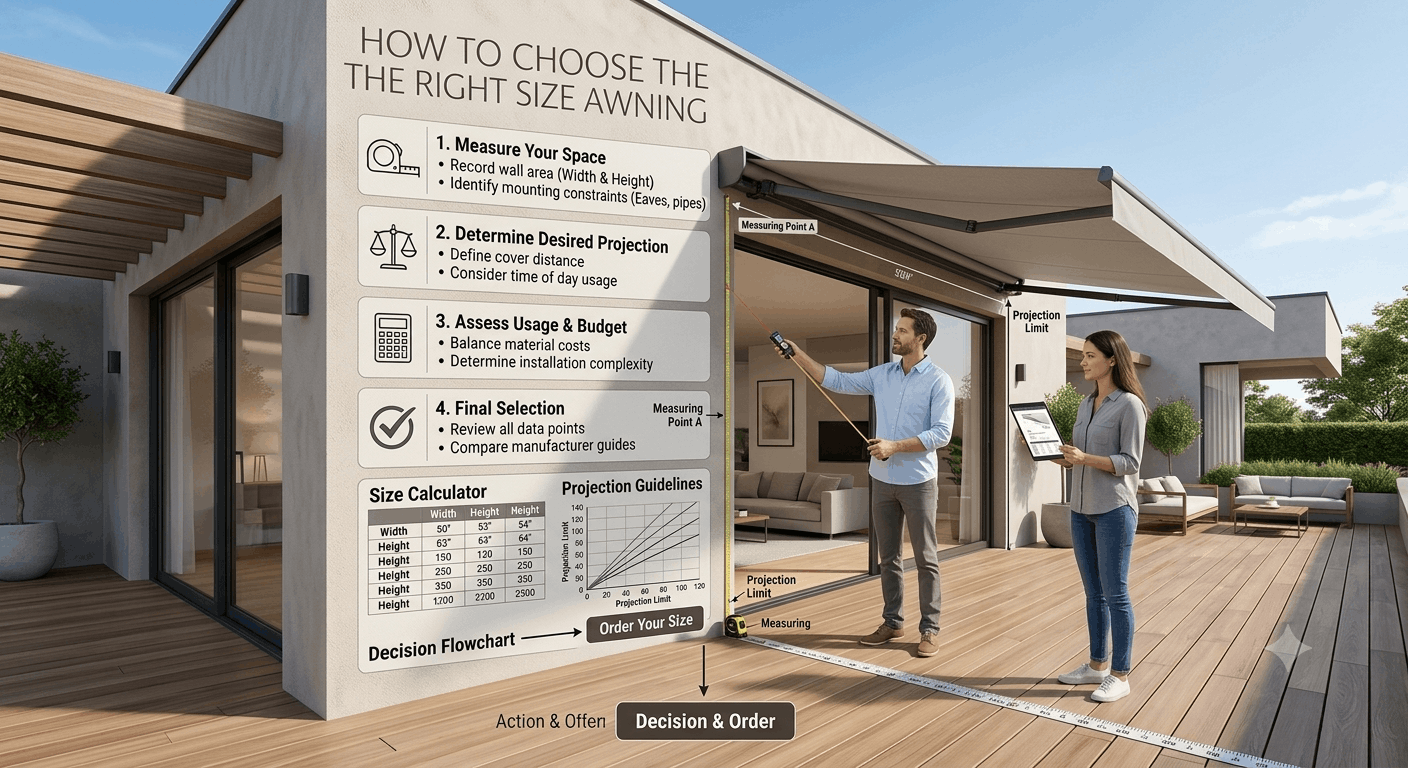
Step 1 – Measure Your Outdoor Living Space
Start here, before you look at any product specifications. The foundation of every awning size decision is the actual patio dimensions, width first, then depth.
Measure the full usable width of your outdoor living space, not just the furniture arrangement sitting in it. People move furniture. Guests spill out beyond the chairs. The shade coverage should cover the whole activity zone, not just where things happen to sit today. If your deck area runs six metres wide, that’s the number that matters, not the four-metre spread of your current outdoor setting.
For awning width, the goal is to match or slightly exceed the width of the space you want shaded. Standard residential awnings run from around 2.5 metres up to 7 metres or more in width, so most patios fall within range, but measuring first means you’re working with a real number, not an estimate.
One thing that trips people up at this stage: the width of your outdoor living space and the wall space available for mounting are often two different measurements. A patio might be six metres wide, but if windows, door frames, or architectural features interrupt the exterior wall, your usable mounting width could be less. Measure both, you’ll need them at the next step.
Step 2 – Understand Awning Projection
Awning projection is the depth of shade, how far out from the wall the awning extends over your patio. It’s arguably the most misunderstood dimension in the whole sizing process, and getting it wrong is the most common reason people end up with an awning that doesn’t do the job.
Here’s why it’s more nuanced than it looks: projection doesn’t just determine the footprint of the awning itself. It determines how much of the deck area falls in usable shade based on the sun’s angle at different times of day. In summer, when the sun sits high in the sky, you need more projection to push shade out far enough to cover the space below. In the early morning or late afternoon, with the sun lower on the horizon, the shade angle works in your favour and less projection is needed.
A practical starting point: your awning projection should be at least two-thirds of the depth of the space you want shaded. If your patio runs four metres deep from the wall, aim for at least 2.5 to 3 metres of projection.
This is where a retractable awning has a clear advantage over a fixed shade structure. You can adjust the projection depending on sun exposure conditions, extend fully on harsh afternoons, pull back slightly on milder days. The coverage area adapts rather than being locked into one position. That flexibility is worth factoring into the decision.
Step 3 – Check Your Wall Space and Mounting Height
With your patio dimensions and projection target in hand, the next step is understanding what the exterior wall can actually accommodate, because this is where many awning projects hit unexpected constraints.
Measuring usable wall space
Don’t measure the rough wall area. Measure from fixed obstruction to fixed obstruction — window frame to door frame, architectural feature to corner, whatever the actual boundaries are. That’s your real awning width ceiling. If the usable wall space comes in narrower than the patio width you measured in Step 1, the wall constraint wins. An awning installation can only be as wide as the wall allows.
Mounting height
The awning needs to be mounted high enough that when it’s extended, there’s adequate clearance beneath it. A general rule is at least two metres of clear height below the extended awning at its lowest point, enough for people to move under it comfortably without ducking. Too low and it becomes an obstacle. Too high and the projection angle changes, affecting shade coverage at ground level.
Roofline clearance
This one gets overlooked until the installation stage, and it shouldn’t. The top of the awning cassette, the housing that holds the rolled fabric when the awning is retracted, needs to sit clear of the roofline, guttering, or any overhead structure above it. If that clearance doesn’t exist, the awning physically can’t be installed at the intended height. Measure from the proposed mounting point up to the roofline before finalising any size decisions, and flag anything close to your installer before ordering.
A professional awning installation assessment is genuinely useful here. Constraints that aren’t obvious from basic measurement, wall construction type, structural fixing points, overhead obstructions ,become apparent early rather than on installation day.
Step 4 – Match Awning Size to Sun Exposure and Usage
The numbers from your measurements give you the boundaries. How you actually use the space tells you where within those boundaries to land.
Sun exposure pattern is the first consideration. A west-facing patio cop the harshest afternoon sun, the kind that makes an outdoor space genuinely unusable between 2pm and 6pm in summer. For these orientations, maximum awning projection and full shade coverage matter most. A north-facing patio gets more consistent sun across the day, which may call for a wider awning rather than a deeper one. Morning-facing patios often need less projection overall, since the sun is lower and moves away from the space as the day progresses.
Usage shapes the size decision just as much. An outdoor entertaining space that regularly hosts groups needs wide, generous coverage, shade that stretches across seating, a dining table, and movement space between them. A quieter patio used mainly for morning coffee and weekend reading has different demands. Patio furniture arrangements for two can work comfortably under a narrower retractable shade; a regular gathering spot for eight cannot.
Think about when you use the space most. If it’s afternoon entertaining in summer that drives the purchase, size for that scenario, maximum sun protection at the worst angle, covering the full seating area. If the space is used across the day in varying conditions, a retractable awning with good projection range gives you the flexibility to adapt rather than being locked into one coverage position.
Custom vs Standard Awning Sizes
Standard awning sizes cover a lot of ground, and for a straightforward rectangular patio with a clear, unobstructed wall, an off-the-shelf width and projection often fits well. But plenty of real outdoor spaces don’t behave that neatly.
Irregular deck areas, wide open-plan spaces, patios that wrap around a corner, walls with multiple obstructions, or spaces where the required projection falls outside standard ranges, these are the situations where a custom awning stops being a premium option and starts being the practical one. Forcing a standard size into a space that doesn’t suit it means accepting either under-coverage or an awkward visual result that’s hard to undo once it’s installed.
A custom awning lets you specify exact awning width and projection depth to match the measured space precisely. Awning fabric can be chosen to suit the sun exposure level heavier weaves for intense direct sun, lighter options where full shade isn’t the priority. The cassette and hardware are specified to suit the exterior wall, not worked around it.
Talius retractable awnings are available in custom configurations for exactly this reason. Not every patio fits a catalogue, and the measurement process that goes into a custom order means the result actually covers what it’s supposed to cover.
Common Awning Sizing Mistakes to Avoid
A few recurring errors are worth naming directly, because they’re easy to make and harder to fix after installation:
Measuring the furniture instead of the space. Your current outdoor setting is not the permanent definition of your patio. Measure the full usable area the furniture arrangement can change, the sun can’t.
Ignoring wall space constraints. Ordering an awning wider than the available mounting width creates an installation problem that no amount of enthusiasm solves on the day. Measure the wall before you commit to a width.
Underestimating projection for afternoon sun. Morning sun is forgiving. West-facing afternoon sun is not. If that’s your exposure, err toward more projection rather than less.
Forgetting roofline clearance. Measure up, not just across. The cassette needs somewhere to sit, and discovering it doesn’t fit at the installation stage is an expensive lesson.
Choosing standard sizing when patio dimensions clearly call for custom. The price difference between standard and custom is usually smaller than people expect. The difference in performance and appearance is not.
Skipping a professional measuring assessment. An experienced installer will spot constraints in ten minutes that would take a homeowner several frustrating hours and potentially a return visit to uncover.
FAQ
How wide should a patio awning be? Ideally, the awning width should match or slightly exceed the full usable width of the space you want shaded, not just the furniture spread. Measure the complete activity zone, then check your available wall space to confirm the mounting width is achievable.
How much projection do I need for full shade coverage? A reliable starting point is at least two-thirds of the depth of the space you’re shading. For a four-metre deep patio, aim for 2.5 to 3 metres of projection. Sun exposure angle at your specific orientation may push that figure higher, west-facing spaces generally need more.
What is the standard size for a retractable awning? Residential awnings typically range from around 2.5 metres to over 7 metres in width, with projections from around 1.5 to 4 metres depending on the model. Standard sizes cover many common patio dimensions, but irregular spaces or wide openings often benefit from custom sizing.
How high should an awning be mounted? As a general guide, the awning should be mounted so there’s at least two metres of clearance beneath it when extended. The exact mounting height also affects the shade angle, so it’s worth discussing with your installer relative to your specific sun exposure and patio layout.
Do I need a custom awning if my patio is an unusual size? Quite possibly. If standard widths or projections don’t match your patio dimensions, a custom awning gives you precise coverage without compromise. For spaces with wall obstructions, wide openings, or specific sun exposure requirements, custom sizing is usually the better long-term investment.
Bottom Line
Four measurements drive the right awning size decision: patio width, projection depth, available wall space, and mounting height. Get those right and match them to when and how you actually use the space and the rest of the decision falls into place naturally. It’s not complicated, but it does require measuring before browsing. A retractable awning sized properly for your outdoor living space will deliver years of genuine outdoor comfort. One that isn’t will remind you of that every sunny afternoon.