There’s a moment every homeowner knows you fling open the patio doors on a warm evening, and within minutes, you’re sharing the room with every flying insect in the neighbourhood. Flyscreens solve that. But which kind? Fixed screens have been around forever. Retractable flyscreens are changing what’s possible. Here’s an honest look at both, so you can choose what actually works for your home.
What Are Fixed Flyscreens?
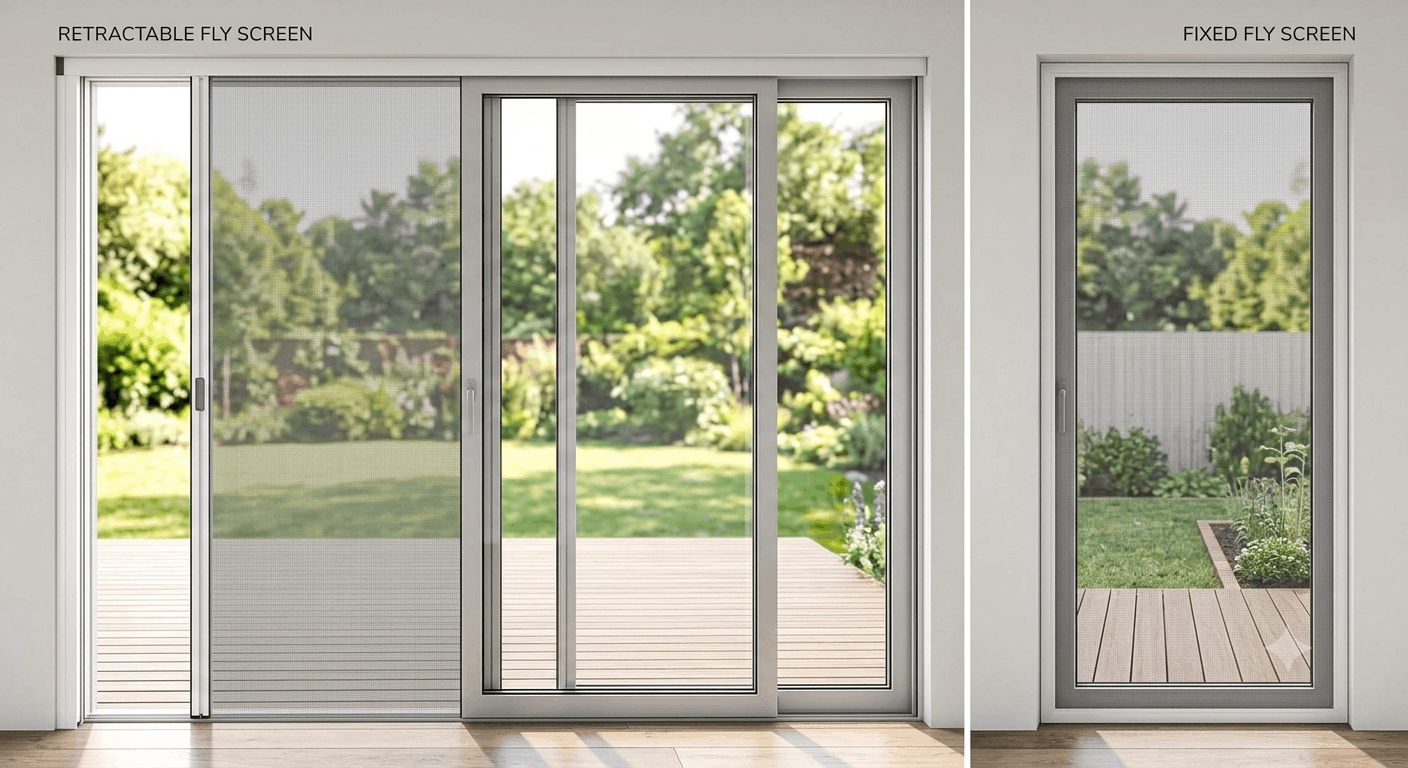
Fixed screens are exactly what they sound like: a permanent mesh panel held in place by a rigid screen frame, usually an aluminum frame, that stays on your window or door opening year-round.
They’ve been the go-to insect protection solution for decades, and for good reason. They’re simple, affordable, and reliable. Once installed, you don’t have to think about them, the mesh is always there, letting in fresh air and natural ventilation while keeping insects out.
They work well on standard windows and single hinged doors where the opening is consistent and the frame isn’t in the way. Installation is straightforward, maintenance is minimal, and the cost is generally lower than more advanced screen systems.
The tradeoffs, though, are real. The screen frame is always visible. The mesh sits between you and the outside world whether you want it there or not subtly filtering your view, interrupting your sightlines, and in some cases clashing with the clean lines of a modern home. And for larger openings like sliding doors or bi-fold doors, a fixed frame simply doesn’t work the mechanics don’t allow for it.
What Are Retractable Flyscreens?
Retractable flyscreens take a different approach. Rather than living permanently in your opening, they roll away into a screen housing cassette when you don’t need them and deploy smoothly when you do.
The cassette is the key component. It houses the rolled mesh and the tensioning mechanism, and it sits discreetly against the door or window frame. When you want insect protection, you pull or slide the screen across the opening. When you want an unobstructed view or you’re moving furniture in and out, you retract it completely. The opening is clean. The sightlines are clear. The screen is there when it needs to be, invisible when it doesn’t.
Retractable flyscreens come in manual and motorized options, with automated models allowing you to operate them with a remote or integrate them into a smart home system.
Where they really come into their own is on larger and more complex openings, sliding doors, French doors, bi-fold doors, patio doors, and wide architectural openings where a fixed screen frame would be impractical or visually disruptive. These are the exact openings that define indoor-outdoor living in modern home design, and retractable screens are built for them.
Head-to-Head: How Do They Actually Compare?
Aesthetics & home design
A fixed screen frame is always part of the picture. Depending on your home, that may be perfectly fine or it may feel like a permanent visual interruption you learn to tolerate rather than love.
Retractable flyscreens are designed around the idea that the best screen is one you can’t see. When retracted, the only visible element is the slim cassette housing, which can be colour-matched to your door or window frame. For homes where clean lines and home aesthetics matter, that’s a meaningful difference.
Natural light & views
The mesh in a fixed screen doesn’t block much but it does filter. On a bright day you might not notice, but the view is never quite as sharp or open as it would be without a screen sitting in the frame.
With retractable flyscreens, you simply pull them back. Natural light comes through fully, sightlines stay sharp, and the view from your living room to your garden or deck is exactly what should be unobstructed.
Ventilation & airflow
Both screen types allow natural ventilation and fresh air when they’re in use, and neither significantly restricts airflow through the mesh. If your primary goal is ventilation, either option delivers.
Where retractable screens edge ahead is on larger openings. A wide set of patio doors or bi-fold doors opened fully with a retractable screen spanning the whole space allows far more airflow than any standard fixed screen could accommodate. The scale of the opening makes the difference.
Door & window compatibility
This is where the choice often becomes clear. Fixed screens work on standard windows and single doors. They’re not designed for and can’t really accommodate sliding doors, bi-fold doors, French doors, or large architectural openings. The frame geometry doesn’t allow for it.
Retractable flyscreens are engineered specifically for these situations. Whether it’s a set of French doors opening onto a garden, bi-fold doors that fold back completely, or a wide patio opening that blurs the line between inside and out, retractable screens handle them without compromise.
Indoor-outdoor living
If your home is designed around a connection to the outdoors, a deck, courtyard, garden, or pool area accessed through large doors, fixed screens will always be in the way to some degree. The mesh is there. The frame is there.
Retractable screens let you decide. Hosting a dinner party and carrying food back and forth? Retract them. Sitting still on a summer evening when the mosquitoes come out? Deploy them. That flexibility is what makes them the natural fit for genuine indoor-outdoor living.
Installation & maintenance
Fixed screens are cheaper and simpler to install a straightforward job for any screen installer. They’re also easy to replace if the mesh gets damaged.
Retractable screens cost more and require professional installation to ensure the cassette is properly aligned and the mechanism operates smoothly. However, a quality retractable screen built with a durable aluminum frame and robust cassette housing is designed to last for years with minimal upkeep.
| Fixed Screens | Retractable Flyscreens | |
| Aesthetics | Always visible | Hidden when not in use |
| Natural light | Slightly filtered | Fully unobstructed |
| Sightlines | Partially interrupted | Completely clear when retracted |
| Airflow | Good on standard openings | Excellent on large openings |
| Door compatibility | Windows & hinged doors | Sliding, bi-fold, French, patio doors |
| Indoor-outdoor living | Limited | Excellent |
| Installation cost | Lower | Higher |
| Maintenance | Minimal | Minimal |
Which One Is Right for Your Home?
The honest answer is that it depends on what you’re working with.
Fixed screens make sense if you have standard windows or single hinged doors, you want a simple and cost-effective insect barrier, and aesthetics aren’t a primary concern.
Retractable flyscreens are the better choice if you have sliding doors, bi-fold doors, French doors, or large patio openings, or if you care about keeping your home looking the way it was designed to look. If indoor-outdoor living is part of how you actually use your home, and if unobstructed views and natural light matter to you, retractable screens aren’t a luxury upgrade, they’re the practical choice.
Why Talius Retractable Flyscreens Stand Out
Talius has been designing and manufacturing screens for over 40 years, and their retractable flyscreens reflect that experience in the details of the quality of the screen housing cassette, the durability of the aluminum frame, the smooth operation across openings of all sizes.
What sets them apart is the engineering behind large and architectural openings. Most standard retractable screens are designed for modest-sized openings. Talius flyscreens are built to span wide sliding doors, double French doors, and large architectural openings without the mechanism sagging, sticking, or losing tension over time.
They’re used across residential homes, commercial properties, and institutional buildings which means the same product that’s protecting a school corridor is available for your patio doors.
If you’re weighing your options, the Talius flyscreens are a good starting point to see what configurations are available for your specific opening.
Frequently Asked Questions
Can retractable flyscreens be used on bi-fold and French doors? Yes, retractable flyscreens are specifically designed for bi-fold doors, French doors, and other multi-panel door configurations where a fixed screen frame wouldn’t be practical. They span the full opening and retract cleanly when the doors are in use.
Do retractable screens block natural light? When deployed, the mesh allows natural light to pass through while blocking insects. When fully retracted into the cassette, they have zero impact on natural light; the opening is completely clear.
Are retractable flyscreens better than fixed screens for ventilation? Both allow good natural ventilation when in use. Retractable screens have an advantage on large openings: a fully open bi-fold or patio door with a retractable screen delivers significantly more airflow than a fixed screen on a standard opening.
How long do retractable flyscreens last? A quality retractable flyscreen with a durable aluminum frame and well-engineered cassette mechanism should last many years with basic maintenance. Longevity depends on the quality of the product and correct installation.
What is a screen housing cassette? The screen housing cassette is the compact unit that houses the rolled mesh when the screen is retracted. It sits alongside the door or window frame and keeps the mesh protected and under correct tension, ready to deploy when needed.
Bottom Line
Both screen types do the job insects out, fresh air in. But they’re not built for the same homes or the same openings. If you have large doors, care about sightlines, or want your living space to flow naturally outdoors, retractable flyscreens are the clear choice. Fixed screens have their place, but for modern homes designed around light, views, and indoor-outdoor living, the flexibility of a retractable system is hard to argue against.