There’s a frustrating tradeoff that comes with big windows and open living spaces, the more light you let in, the more exposed you feel. Neighbors glancing over, pedestrians with a clear view into your living room, or a sun-drenched patio that feels more like a fishbowl than a retreat. Most people reach for blinds and immediately lose the light they wanted. Exterior privacy screens exist precisely to fix that, and they do it better than almost anything else on the market.
The Problem With Traditional Window Treatments
Interior blinds and curtains work on a simple principle: block the view by blocking everything. The result is a room that feels closed off, dim, and disconnected from the outside, especially frustrating in rooms that face a garden, a street, or a neighbor’s property.
What most homeowners don’t realize is that where you install a shading solution matters as much as what you install. Exterior solar screens intercept sunlight and sightlines before they ever reach your glass which means they handle both privacy and heat at the source, rather than reacting to them after the fact.
The difference in how a room feels is significant. You keep the openness. You keep the brightness. You lose the exposure.
How Exterior Privacy Screens Actually Work
The reason exterior screens can provide privacy without blocking natural light comes down to a straightforward optical principle called the visibility contrast effect.
During daylight hours, the outside of your home is brighter than the inside. When light hits a woven solar screen material from the outside, the screen scatters and diffuses it, allowing soft daylight filtering to pass through while the darker interior remains essentially invisible from outside. From your side, you can see out clearly. From the street, all anyone sees is the screen surface.
This is the one-way daytime privacy effect, and it’s the core mechanic that makes these products work.
It’s worth being upfront about one limitation: this effect only holds during the day. At night, when your interior lights are on and the outside is dark, the contrast reverses. The inside becomes the brighter environment, and the screen’s privacy benefit largely disappears. For nighttime coverage, a secondary layer of sheer roller shades or silhouette blocking window films fills that gap.
Understanding Light Transmission and Openness Factor
Two numbers matter most when choosing an exterior screen: light transmission percentage and openness factor percentage.
Light transmission refers to how much total light passes through the fabric. Openness factor typically ranging from 1% to 14% describes the physical size of the gaps in the weave. A 1% openness factor is a very tight weave; a 14% is noticeably more open. The tighter the weave, the more privacy, the more heat blocked, and the less light passes through. The more open the weave, the clearer your view but the less privacy protection you get.
Here’s a practical breakdown:
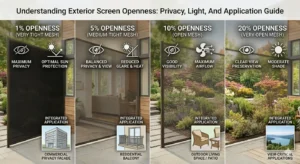
Most residential applications land in the 3%–7% range enough to block sightlines completely during the day while still filling the room with diffused natural light that feels soft, even, and genuinely pleasant to be in.
It’s Not Just Privacy It’s Better Light
One thing that often surprises people after installation is how the quality of light changes. Direct sunlight through unshielded glass is harsh, it creates hot spots, washes out screens, and causes the kind of squinting glare that makes you reach for the blinds anyway.
Exterior solar screens scatter that light before it enters. The result is diffused natural light that’s easier on the eyes, more evenly distributed across a room, and far more livable. Glare reduction without blocking the view is one of those benefits that’s hard to appreciate until you experience it firsthand, and once you do, standard blinds feel like a significant step backward.
What the Screens Are Actually Made Of
The performance of any exterior privacy screen depends heavily on the fabric, and there are a few materials you’ll encounter most often.
PVC-coated polyester mesh is the industry workhorse. It’s weather-resistant, dimensionally stable, easy to clean, and holds up well under repeated use with motorized systems. Most Talius Habitat Screens use variations of this construction.
HDPE shade fabric high-density polyethylene screening, is lighter and more breathable. It’s a popular choice for patio enclosures and sunroom privacy systems where airflow matters and the screen won’t face the same mechanical stress as a window application.
Vinyl-coated fiberglass screens are the heavy-duty option, rigid, dimensionally stable, and built for commercial or institutional settings where durability over decades is non-negotiable.
Whatever the base material, look for UV-resistant outdoor fabric with documented weathering ratings. Cheaper screens fade, shrink, and lose structural integrity within a few seasons. Quality woven solar screen material maintains its openness factor and color consistency for years, which matters because your privacy performance depends on the weave staying intact.
Breathable mesh fabric is also worth prioritizing for any application where the screen sits close to an outdoor living area, it allows air movement rather than creating a heat pocket against the glass.
The Energy Efficiency Angle (That Most People Overlook)
Privacy is the headline benefit, but solar heat gain reduction might be the reason these screens pay for themselves.
When sunlight hits a window, it doesn’t just illuminate the room, it deposits heat directly into the glass and the space beyond. Interior blinds can only manage that heat after it’s already inside. Exterior screens intercept solar radiation before it reaches the glass, which is a fundamentally more effective approach.
The result is meaningful indoor temperature reduction in sun-facing rooms particularly in summer when west and south-facing glazing can turn a comfortable living room into an uncomfortable one by early afternoon. Less heat entering the building means less work for your air conditioning system, which translates to genuine cooling load reduction and lower energy costs over time.
For commercial projects, this efficiency benefit carries additional weight. Talius products qualify as energy-efficient shading systems under LEED guidelines relevant for architects and developers working toward certification on commercial and institutional builds. The principle of passive solar shading, where the building itself (or its shading elements) manages solar exposure without mechanical intervention, is increasingly valued in climate-responsive design.
Where These Systems Make the Most Sense
Exterior privacy screens are versatile enough to work across a wide range of settings, but they’re particularly well-suited for:
Street-facing windows – the most common driver for residential inquiries. A low openness factor (1%–3%) on a front-facing window eliminates the fishbowl effect completely while keeping the room bright.
Sunrooms and glass-heavy additions – sunroom privacy without darkening the space is exactly what these products were designed for. A mid-range openness factor preserves the airy feel while making the space genuinely usable on sunny days.
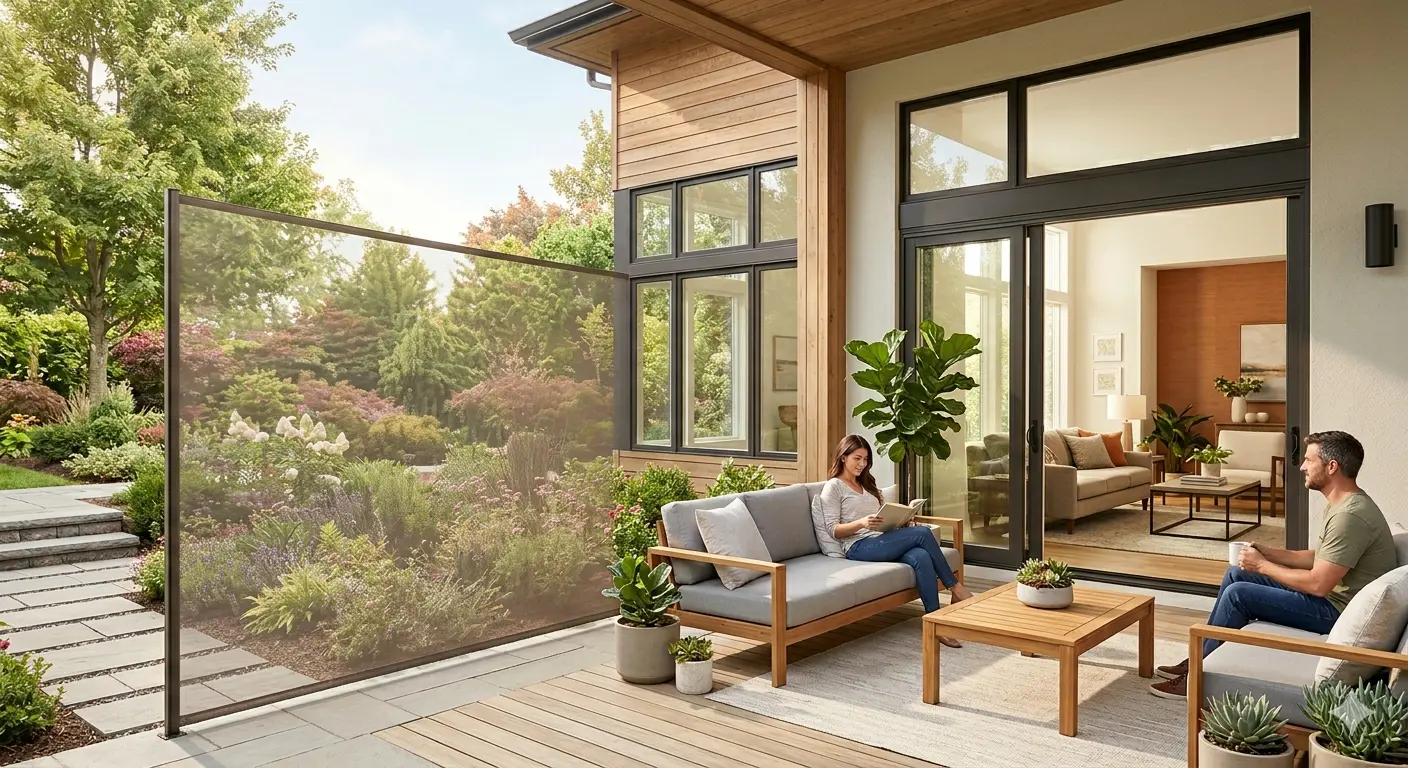
Patios and outdoor living areas – porch privacy screens and retractable patio screens create a sense of enclosure without the heaviness of a solid fence or wall. They define a space without closing it off.
Windows facing neighbors – angle and openness selection matter here. A screen that works at straight-on sightlines may still allow peripheral viewing; a 3%–5% fabric handles most angles comfortably.
Commercial glass facades – heat and privacy control for glass walls is a real operational concern in open-plan offices and retail environments. Exterior solar screens reduce glare for occupants and heat load for building systems simultaneously.
Types of Systems: From Simple to Smart
Not every exterior screen system looks or operates the same way. The right configuration depends on your opening size, how often you want to adjust coverage, and your budget.
Fixed exterior screens are permanently installed and offer the lowest cost entry point. They’re appropriate for openings where you want consistent coverage year-round with no operational complexity.
Motorized outdoor shades are where most residential and commercial buyers land today. They can be operated via remote, wall switch, or integrated into a smart home system through smart shade automation. Sun sensors can trigger deployment automatically when solar intensity crosses a threshold genuinely useful for south-facing rooms that only need coverage during peak hours.
Retractable patio screens give you full flexibility, deploy for privacy and shade, retract when you want unobstructed views or maximum airflow. They’re the right answer when conditions vary significantly throughout the day or season.
Dual-layer shade systems pair an exterior solar screen with an interior sheer or blackout layer. This is the most complete solution for spaces that need daytime privacy AND nighttime coverage, the exterior screen handles the day, the interior layer handles the night.
For installation, outside mount coverage provides the most complete edge-to-edge protection. Inside mount options are available but can leave edge gap light leakage at the sides, something worth discussing with your installer before committing to a configuration.
Frequently Asked Questions
Can I really see out if neighbors can’t see in? Yes during daylight hours. The visibility contrast effect works because the exterior is brighter than the interior. You have a clear outward view; from outside, the screen surface is what’s visible, not your interior.
What openness factor should I choose for a street-facing window? For maximum daytime privacy with street-level exposure, a 1%–3% openness factor is the standard recommendation. It blocks sightlines at virtually any angle while still transmitting enough light to keep the room from feeling closed.
Do these screens work at night? Not for privacy on their own. Once interior lighting makes your space brighter than the outside, the contrast reverses and the privacy benefit disappears. A privacy layering system, exterior screen plus interior sheer or blackout, covers both scenarios.
Are exterior screens more energy-efficient than interior blinds? Significantly. Because they block solar heat gain before it enters the glass, exterior screens outperform interior treatments for temperature management. Interior blinds can only manage heat that’s already inside the room.
Can exterior screens be automated? Yes. Motorized systems compatible with most smart home platforms are standard across Talius’s product range, including sun-sensor integration that automates deployment based on real-time solar intensity.
Bottom Line
Getting privacy without sacrificing natural light isn’t a compromise, it’s exactly what exterior solar screens are engineered to deliver. Choose the right openness factor for your exposure level, invest in quality UV-resistant fabric, and consider motorization if your conditions change throughout the day. The result is a home or workspace that feels genuinely open, comfortable, and private all at once.
Here’s a practical breakdown: